
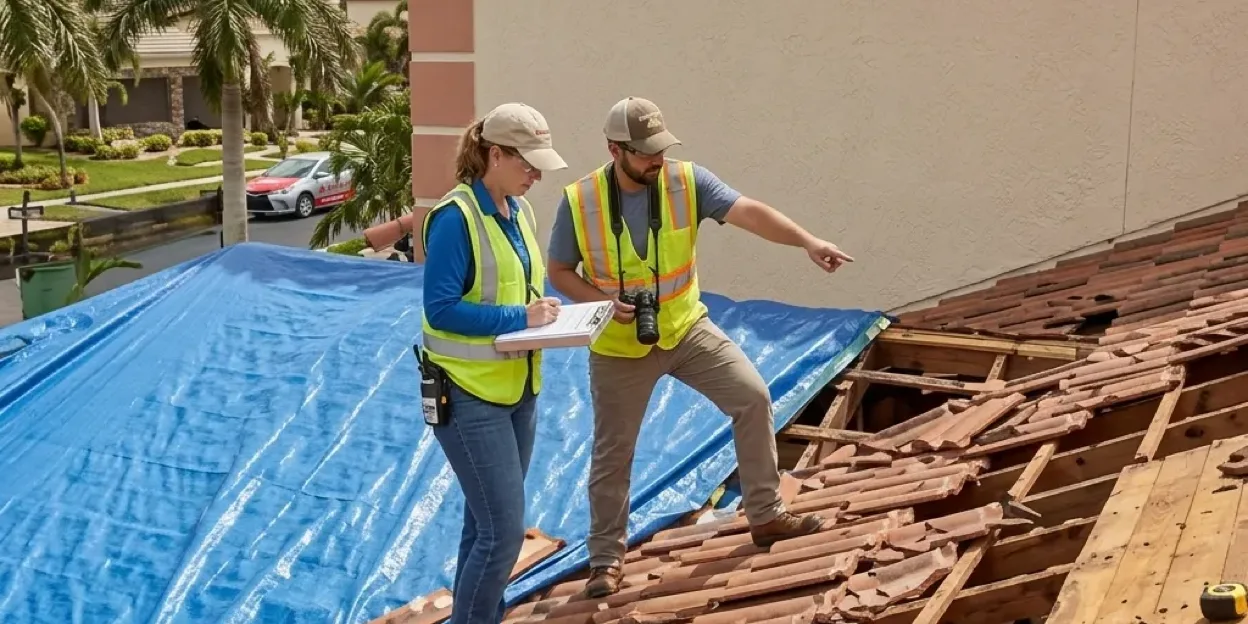
The adjuster is coming Thursday. The tarp has been on the roof since the storm, you have forty photos on your phone, and you are not sure what he is going to want to see. This site connects you by phone with an independent local roofing contractor who documents roof damage in Collier County. It is not a public adjuster, a law firm, or an insurer, and nothing here is legal advice.
The contractor's job in a claim is documentation. They walk the roof and photograph each slope, count damaged tiles or shingles, mark where underlayment is torn, and note whether the plywood is wet. They separate what the storm did from what was already worn. Then they write a line-item scope: materials, quantities, labor, permit, and what has to come off to fix what is damaged.
On tile roofs they add the details that decide repair versus replace: the profile, the manufacturer if it can be read, how the tile was set, and whether a matching tile exists. Many contractors will meet the adjuster on the roof so the two are looking at the same thing.
Photograph the damage inside and out before anything is moved. Get the roof tarped and keep the receipt; emergency protection is normally part of the claim, and your policy requires you to prevent further damage. Call your insurer and get a claim number.
Then find your policy's declarations page and read three lines: the hurricane deductible, which is usually 2 to 5 percent of dwelling coverage on a named storm; the notice-of-claim deadline; and whether the roof is covered at replacement cost or actual cash value. A roof over a certain age on an actual-cash-value schedule pays out less, and that is worth knowing before Thursday.
Nobody on this site can tell you what your policy will pay. As a general pattern, sudden wind damage from a storm is the kind of loss a Florida homeowner policy is written for. Wear, age, worn-out underlayment, and leaks that have been running for months are usually treated as maintenance and excluded. Matching a discontinued tile can go either way, and Florida has rules about matching that your adjuster knows and you may not.
Once the insurer issues its decision, the repair is a storm damage or replacement job with a permit pulled through the county or city. A disputed claim is a job for a licensed public adjuster or an attorney, not a roofer.
Florida rewrote its property insurance law in December 2022, three months after Ian. Three changes matter for a roof claim. A new claim must be reported within one year of the date of loss, down from two, and a supplemental claim within 18 months. Assignment of benefits, where a contractor takes over your claim, is no longer allowed on residential policies issued on or after January 1, 2023, so the claim stays in your name. And since May 2022, a carrier cannot refuse to renew solely for roof age if the roof is under 15 years old or an inspection shows five or more years of life left.
The Florida Office of Insurance Regulation publishes the wind-mitigation form (OIR-B1-1802) that carriers use to price the wind portion of a premium, and a new roof documented on that form is often the thing that changes a renewal quote. Many Collier County homes that lost private coverage after Irma and Ian ended up with Citizens Property Insurance, the state-backed carrier, which has its own roof-age and inspection rules at renewal.
A roof inspection report from before the storm is the single most useful document in a claim, because it proves what the roof looked like the week before.
Have the address, the storm date, the claim number, the adjuster's visit date if scheduled, and your policy's declarations page. Say whether the roof is tarped and whether the home is occupied. Call (239) 341-5474.
 Standing by
Describe the roof in plain words. The call is routed to an independent local roofing contractor who works tile, metal, and shingle roofs in your part of Collier County.
A slipped tile, a lifted shingle, a cracked pipe boot, or a valley that leaks in every afternoon storm, found and fixed before the next one.
Tear-off to the deck, new underlayment, and a new tile, metal, or shingle roof permitted through Collier County or the city.
Tarping, photos, and repair after wind, a fallen palm, or a named storm opens the roof.